
The digital marketing world is evolving faster than ever, and Artificial Intelligence is at the centre of this transformation. By 2026, businesses that fail to adopt AI tools for digital marketing will struggle to compete in an ecosystem driven by automation, data, and personalization.
From smarter content creation to predictive analytics and automated campaigns, AI is redefining how marketers plan, execute, and optimize strategies. This blog explores the most important AI-powered tools, how they impact marketing workflows, and why every digital marketer must embrace them to stay ahead.
Why AI Is No Longer Optional for Digital Marketers
Consumer behaviour today is dynamic, multi-channel, and data heavy. Manual marketing efforts can no longer keep up with this complexity. This is where AI tools for digital marketing play a critical role by processing massive datasets, identifying patterns, and delivering actionable insights in real time.
AI helps marketers:
- Automate repetitive tasks
- Improve targeting accuracy
- Personalize user experiences
- Reduce campaign costs
- Increase return on investment
In 2026, success will depend on how effectively marketers collaborate with AI.
How AI Is Transforming Digital Marketing in 2026
AI is not just an enhancement—it is becoming the foundation of modern marketing systems. Search engines, social platforms, and ad networks already rely heavily on artificial intelligence, making it essential for marketers to align their strategies accordingly.
By using AI tools for digital marketing, professionals can predict trends, optimize campaigns automatically, and make faster decisions backed by data instead of assumptions. This shift allows marketers to focus more on creativity, strategy, and business growth.
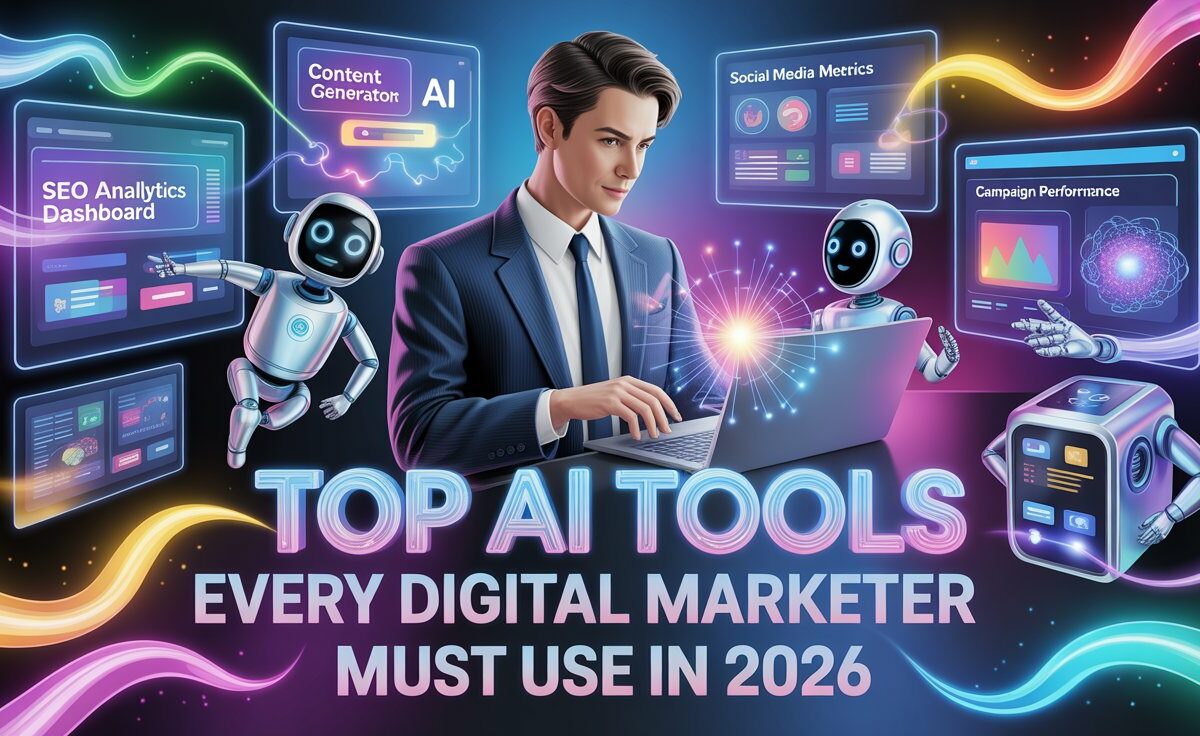
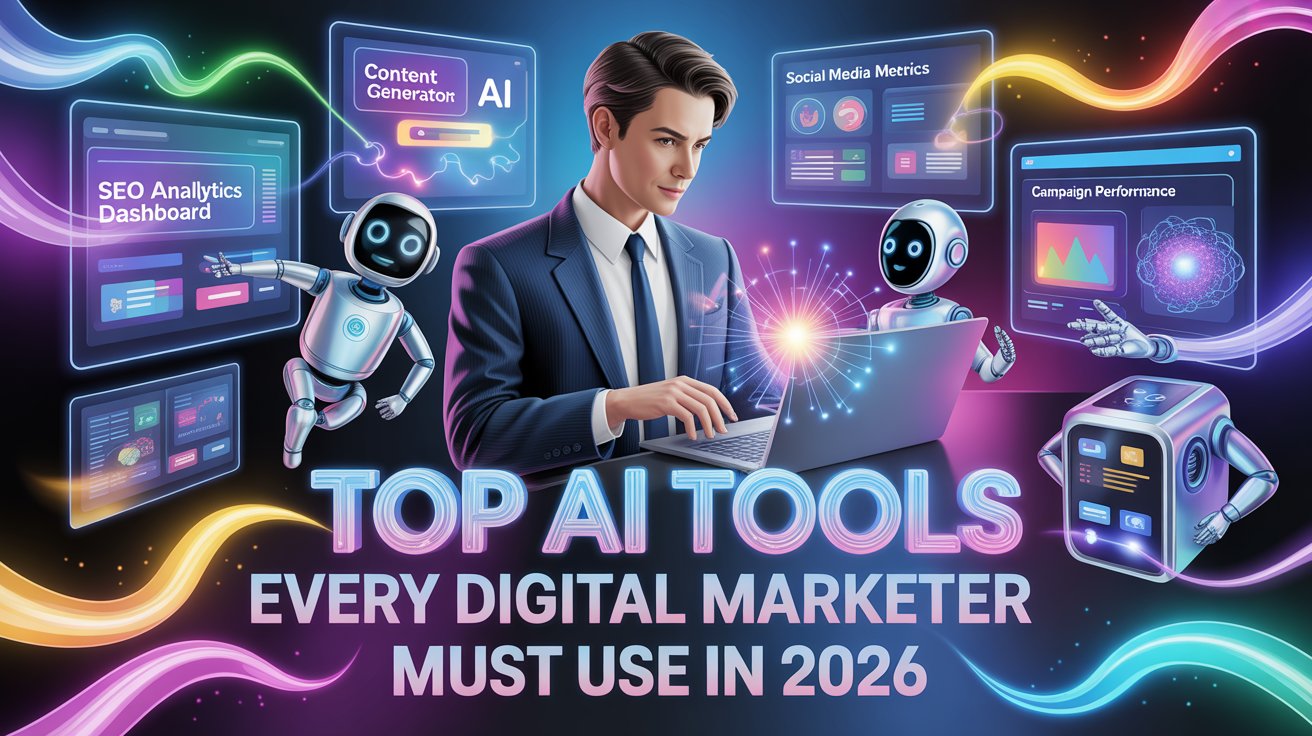
Top AI Tools Every Digital Marketer Must Use in 2026
AI Tools for Content Creation
Content remains the backbone of digital marketing. AI-powered content tools help generate blogs, ad copies, landing pages, and social media posts efficiently.
These tools assist with:
- Content ideation
- SEO-optimized writing
- Headline generation
- Multilingual content
In 2026, smart marketers will use AI as a creative assistant rather than a replacement.
AI Tools for SEO & Data Analytics
Search engine optimization has become highly technical, and data driven. Modern SEO relies heavily on AI tools for digital marketing to understand search intent, analyse competitors, and track performance.
AI SEO tools help marketers:
- Identify high-potential keywords
- Analyse SERP behaviour
- Detect technical issues
- Optimize content structure
- Predict ranking changes
These insights enable faster and more precise SEO decisions.
AI Tools for Social Media Marketing
Social media platforms demand consistent engagement and timely content. AI-powered tools simplify content scheduling, performance tracking, and audience engagement.
Benefits include:
- Automated post scheduling
- Hashtag and caption suggestions
- Best-time-to-post predictions
- Engagement analytics
With AI tools for digital marketing, brands can stay active and relevant across platforms without exhausting their teams.
AI Tools for Paid Ads & Performance Marketing
Paid advertising is becoming increasingly competitive and expensive. AI-driven ad tools help marketers optimize budgets and improve conversions.
These tools can:
- Identify high-converting audiences
- Automatically adjust bids
- Run real-time A/B testing
- Reduce wasted ad spend
Using AI tools for digital marketing in paid campaigns leads to smarter targeting and better ROI.
AI Tools for Email Marketing & Automation
Email marketing continues to deliver one of the highest ROIs in digital marketing. AI enhances this channel through automation and personalization.
AI-powered email tools can:
- Segment users intelligently
- Personalize subject lines and content
- Optimize send times
- Improve open and click-through rates
This makes email campaigns more relevant, and results driven.
AI Tools for Customer Experience & Chatbots
Customer experience is a key differentiator in 2026. AI chatbots and CX tools provide instant, personalized support across websites and apps.
They help by:
- Offering 24/7 assistance
- Answering FAQs instantly
- Guiding users through sales funnels
- Collecting customer insights
Businesses using AI tools for digital marketing in customer engagement see higher satisfaction and better retention.
Benefits of Using AI in Digital Marketing
The advantages of adopting AI-powered solutions are significant:
- Faster campaign execution
- Better personalization at scale
- Data-driven decision-making
- Improved productivity
- Higher marketing efficiency
When implemented correctly, AI tools for digital marketing enable sustainable and scalable growth.
Skills Digital Marketers Need in the AI Era
To succeed alongside AI, marketers must focus on:
- Understanding AI workflows
- SEO and analytics fundamentals
- Data interpretation
- Prompt optimization
- Creative storytelling
The future belongs to marketers who know how to combine human creativity with AI tools for digital marketing.
Challenges and Limitations of AI Tools
Despite their benefits, AI tools have limitations:
- Dependence on data quality
- Limited emotional understanding
- Over-automation risks
- Ethical and privacy concerns
That’s why human oversight remains essential when using AI tools for digital marketing.
Future of AI in Digital Marketing
Looking ahead, AI will drive:
- Hyper-personalized user journeys
- Predictive marketing strategies
- Voice and visual search optimization
- AI-driven CRO and UX design
The role of digital marketers will evolve—but it will remain crucial.
Conclusion
The future of marketing is intelligent, automated, and data driven. Embracing AI tools for digital marketing is no longer a competitive advantage—it is a necessity. Marketers who adapt early will lead the industry, while those who resist change will fall behind.
AI is not replacing digital marketers. It is empowering them.