
The Rise of AI in the Digital Era
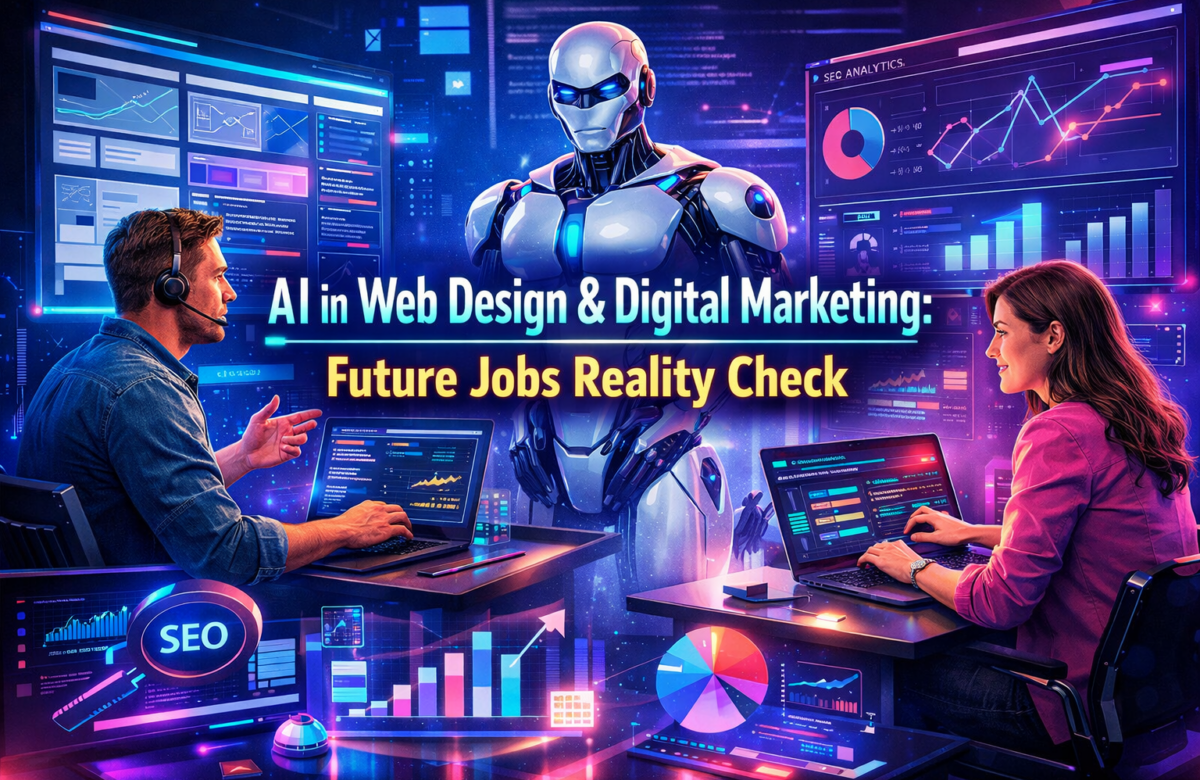
Artificial Intelligence is changing how businesses operate online. From automated website builders to smart ad targeting and content generation, AI is becoming deeply integrated into online growth strategies. This rapid evolution has raised an important question among professionals: will machines take over creative and strategic roles?
The discussion around AI in web design and digital marketing has intensified as businesses look for faster, more cost-effective solutions. While AI offers speed and efficiency, it also raises concerns about job security and creative relevance.
Understanding the Role of AI in Today’s Digital Industry
AI works by analysing data, identifying patterns, and making predictions. It helps companies automate repetitive tasks, optimize performance, and improve decision-making. In the context of AI in web design and digital marketing, these tools assist in layout creation, SEO analysis, campaign automation, and customer behaviour tracking.
However, AI does not think independently. It depends entirely on human input, goals, and creativity to function effectively.
AI and Web Design: Tool or Threat?
AI has introduced powerful tools that simplify the website creation process. From drag-and-drop builders to AI-generated layouts, development has become faster and more accessible.
What AI Can Do in Web Design
AI can:
- Generate website templates
- Suggest layouts and color schemes
- Optimize responsiveness
- Improve loading speed
These advancements strengthen AI in web design and digital marketing, especially for small businesses and startups.
What Human Designers Do Better
Human web designers bring:
- Brand identity creation
- Emotional user experience design
- Custom functionality planning
- Strategic design thinking
Artificial intelligence lacks originality, intuition, and emotional understanding—qualities that define professional design.
AI and Digital Marketing: Automation vs Strategy
Artificial intelligence has significantly improved marketing execution. Tools can now automate ads, analyze keywords, personalize emails, and track performance in real time. This makes AI in web design and digital marketing a powerful asset for scaling campaigns.
Strengths of AI in Marketing
AI excels at:
- Data analysis
- Campaign automation
- Audience segmentation
- Performance optimization
Limitations of AI in Marketing
Despite its strengths, AI cannot:
- Create emotional brand stories
- Understand cultural context deeply
- Make ethical marketing decisions
- Replace creative leadership
Marketing success still depends on human insight and strategic thinking beyond automation.
Creativity, Emotion, and Human Thinking
Creativity is where humans outperform machines. AI produces results based on existing data, while humans invent new ideas. This distinction is central to the debate around AI in web design and digital marketing.
Great websites and campaigns connect emotionally with users. Trust, storytelling, and originality are human qualities that AI cannot replicate authentically.
How AI Is Transforming Careers, Not Eliminating Them
Technology has always reshaped job roles instead of eliminating industries. The rise of Ai in online marketing and website designing is creating new career paths rather than destroying existing ones.
New roles include:
- AI-assisted web designers
- Marketing automation specialists
- UX analysts using AI insights
- Data-driven content strategists
Professionals who adapt and upskill will remain in high demand.
The Future of Web Designers and Digital Marketers
The future is not human versus machine—it is collaboration. AI will handle speed, automation, and analytics, while humans focus on creativity, strategy, and decision-making. In this balanced model, AI in web design and digital marketing becomes a competitive advantage rather than a threat.
Those who learn to work alongside AI will lead the next generation of digital innovation.
Conclusion
So, will AI replace web designers and digital marketers? The reality is clear. AI in web design and digital marketing is a powerful tool, not a replacement for human talent.
AI enhances productivity, but humans define vision. The future belongs to professionals who combine technology with creativity, strategy, and emotional intelligence.